Saturday, February 16, 2013

Unexpected Visitor

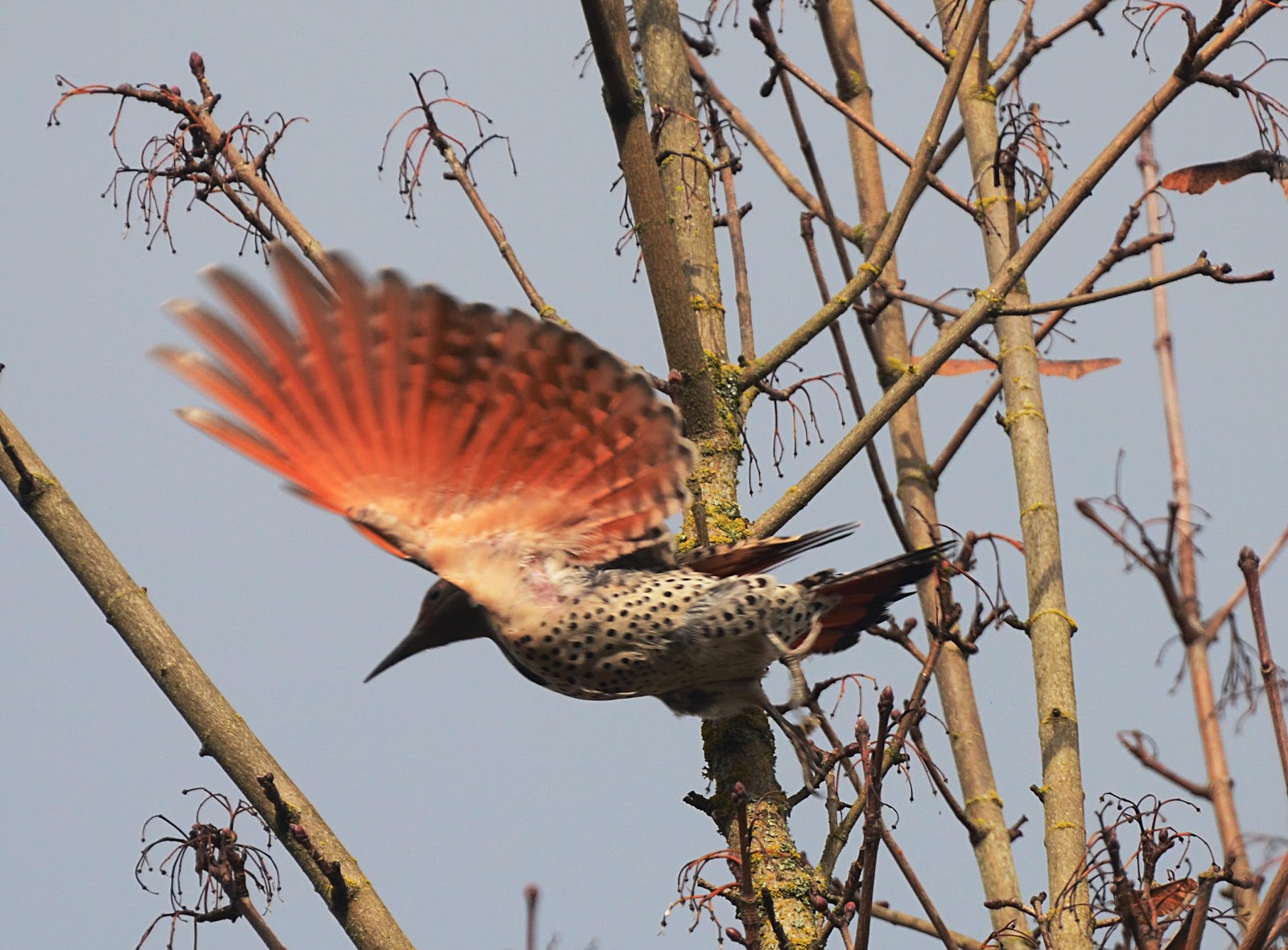
Today was cloudy with 50% chance of rain.  The grey sky does not make an impressive photo.   Nonetheless, as I was watching birds coming to eat at the backyard feeders, I noticed something red moved between the branches at the neighbor's tall maple tree.  Who could it be?


No time to well adjust the camera setting, but I managed to take a few shots.   Look at this red headed bird!!!


"Hi,  it's my first time to get down here. 
I am a Red-breasted Sapsucker."

One of my bird books, "Birds of Oregon," tells me that it is the most common sapsucker in western Oregon, but usually stays in higher elevations.  No wonder.  A few years ago, I've seen one at top of a far away tall tree.  But till today, I have not seen one in my backyard.  Their food are insects, tree sap, and berries.  A male and a female look alike; a juvenile lacks any red.


After the neighbor's maple, it swished to my cedar tree to inspect for any bugs by climbing up and down.

"If I can find enough bugs, I may come back."

Thursday, February 14, 2013

A Happy Valentine's Day

On the lunar calendar, Spring has already arrived on Feb. 4 (立春) this year.  I saw my yellow crocuses in bloom yesterday.


When I took a walk in the afternoon, many neighbors already clipped the roses short ready for the new growing season.   So I followed suit as soon as I returned home.

In the morning, out in the backyard, I  heard American Robins calling before the dawn.  When the sun rose in the eastern sky, I could hear House Finches singing here and there.  Spring is truly here.

"In spring, I sing a Valentine melody."


"Wishing you a Happy Valentine's Day, everyone,"

Monday, February 11, 2013

A Stranger's Visit

In the past when I saw a female Purple Finch, it was mostly brown with a prominent eyebrow.

"I am a female Purple Finch.  I have a white eyebrow."


But the other day I saw a far more whitish bird.  After checking with a bird book, this new hybrid does not have the eyebrow or other characteristics of Purple Finch.  So who is this? 

"Hi, who am I?  I came here with my friend finches for the first time."


"Your roasted sunflower seeds are yummy."
 
 
After reading the bird book thoroughly and checking on the internet further, I have no idea about this new one at this moment.   Some kind of hybrid....  This will be a homework for me.


Saturday, February 9, 2013

California Gull

The Oregon Coast is about 2 hours west of here.  Quite often I see seagulls flying around here.  A big, white bird with a wide wing span   gracefully swishes over my head, but for a camera lens, it is very difficult  to focus on a flying object instantly.

Today the sun was out early in the morning without any fog.  As I spotted a big seagull, I first focused on a nearby tall tree as the bird was heading towards my direction. 

"Here I come."
 
When identifying the bird, I first checked my bird book and limited my choice to three possibilities of seagulls who could be around this region: 

1)  California Gull (a yellow bill with black and red spots)

2)  Thayer's Gull (a yellow bill with dark red spot)

3)  Glaucous-winged Gull (yellow eyes)

I read the descriptions on each bird and I concluded the bird must be a California Gull because it has a yellow bill with black and red spots.  If someone knows more about gulls and thinks otherwise, please let me know.


"Am I a California Gull or not?  Maybe.  I hope so."

Wednesday, February 6, 2013

The Batman and Robin

Most of you probably have seen an old movie called "Batman."  There is a bird who looks just like one.  Can you guess which bird can be?


Here is a Miss Oregon Junco.

"I am black-headed.  Is this good enough?"


A yellow/black bird was trying to fly upwards on the branch.

"It must be me 'cause I have the black mask,"
says a male Townsend's Warbler.

This female does not have the black throat, but....

"Do I also look like one?," asked
a female Townsend's Warbler.


"I think I am the one who looks
like the real Batman," insisted the male.


Backyard Owner:  "I think both of you do look like the Batman in the movie.  From now on, I'll call you Townsend's Warbler aka Batman."


This Robin agrees with me.

"I'm the Robin who acts with the Batman,
so trust me they do look alike."

Sunday, February 3, 2013

Welcome Back, the Blue Sky

This weekend the blue sky returned.   I decided to go out for a short walk.  On the way, I found House Finches singing and even purple crocuses already in bloom at someone's front yard.


Western Scrub-Jays:  "Welcome back, blue sky."


This week every morning, I saw Canada Geese in a huge flock of a hundred or more darting this way and that way, trying to find a prospective feeding ground.

"The other foggy day we were about to get lost. 
Today the coast is clear."


Up in the sky, to my astonishment, four Bald Eagles were soaring in a big circle.  (Couldn't take a good photo of four together, covering so much distance.)
 
  "The warm sun is always welcome."


Friday, February 1, 2013

Protecting the Wildlife

National Wildlife Federation sent me a little card on how to protect wildlife.  Since you read my blog enjoying the wildlife, I would like to share this information with you:

1)  Grow native plants so that pollen, nectar, nuts, cones, berries and other seeds grow easier and better for our climate.

2) Provide water for wildlife.   I keep one shallow birdbath during the cold months (The water for a deep bath, when frozen, can expand and crack the bath).  In summer, I keep 3-4 birdbaths around. The surface of the bath should not be slippery and should be kept close to a tree for immediate escape if necessary.

3)  Create protective cover by growing shrubs, evergreens, and placing hollow logs and rock piles.

My neighbor has a beautiful Blue Spruce in the front yard.
House Sparrow, male:  "This evergreen works for me.  My whole family roost inside.  I know a Scrub-Jay family used to have a nest here.  Often Oregon Juncos stay here, too."

4)  Build birdhouses, attaching to metal poles (for safety from snakes and other slithery dangers), away from the feeding area and the southern exposure (too hot in spring).  To make feeding easier, grow plants for butterfly and moth caterpillars and provide dense plantings to help create a safe nesting area.


"We, Northern Flickers, like to excavate a cavity on a big tree, but if you prepare a nest box with sawdust, I might use it!"