Showing posts with label Info. Show all posts

Wednesday, January 29, 2014

Can You Smell?

The most recent Audubon magazine had an interesting article on birds' ability to smell.  Many scientists have investigated and confirmed that birds can smell to help them to better survive in the wilderness.  Many species of birds have microscopic structure in the forebrain to receive odor signals from the nasal cavity.

Did you see an Oregon Junco lately?  They live around here and come to my backyard in a dozen or two during the cold months.


"Aha, you finally found out I can smell!"


"I search for my mate not just for pretty whiter tails, but for
 more female-like smell for chicks' better survival rate."


Saturday, January 18, 2014

A Mistake

I often use the word "flock" to describe a group of birds.  But Dodd & Elrod with his comic strip says that there are a variety of measuring words to be chosen from.

For example, what would you call a group of Canada Geese?

"We are called a GAGGLE of Canada Geese!"

How about a group of gulls?

"When you see us in a bunch, call us a COLONY of gulls!"


Who is this walking bird?

"A group of ducks should be a BRACE of ducks!"


What eye-opening information!!!

Monday, May 27, 2013

More Black-headed Grosbeak

The other day I found a birding tip in a seasonal magazine from Nature Conservancy. 
 
In it, there is an article called "the Birding Effect," a story about Tom Boucher, a birder/conservationist.  He recommends the best birding time to be overcast, no wind, and no rain.  Also he adds NO TALK.  Even a human voice at the level used inside the library reduces a bird sighting by more than 30%.  So I keep this important message in my mind.
 
A couple of weeks ago, a Black-headed Grosbeak came to my feeders several times during that day.  At the end of the day, unintentionally I scared him away with a loud shutter sound of my camera. 

After that, I longed to see more of them.  Finally my wish was answered:  another one stopped over.

"I think I've been here before.  I can find
a lot of black oil sunflower seeds here."

He comes to a feeder right underneath the patio roof, too. 

"Did you notice this? 
My eyelashes are rather cute."


" I've been here for a few days already. 
I'm fattening up before a trip to the north."

Thursday, March 7, 2013

Spring Rain

Haiku:
                     「春雨や一雨ごとの暖かさ。」
                                                        
                       Spring rain,
                       Every time it falls,
                       Every bit it warms up.
                                                           -author unknown-

"I can feel that everytime the spring
rain comes, it gets warmer!"


I receive seasonal bulletins from Audubon Society of Portland.  On their March/April issue, I found an interesting note by Harry Nehls:

                        As the seasons advance and retreat with the sun's
                        movement, the timing differs with an area's
                        distance from the equator.  For Oregon the seasons
                        best fit the following approximate schedule:
                        - Spring:    Feb 16 - May 15
                        - Summer: May 16 - Aug 15
                        - Fall:        Aug 16 - Nov 15
                        - Winter:   Nov 16 - Feb 15

                        ... if spring comes to Oregon mid-Feb and lasts
                        until mid-May, spring migrations fit well in this
                        framework...

Now that it has been warming up with the spring rains we've had, are you ready for watching more birds? 

Along the Pacific Flyway Zone, birds migrate from Mexico and Southern California to the north such as Canada and Alaska.  On the way, they make numerous rest stops in Oregon.  To welcome them in your backyard, get a plenty of food and water for them.  And sit back and enjoy watching their arrival. 


Friday, February 1, 2013

Protecting the Wildlife

National Wildlife Federation sent me a little card on how to protect wildlife.  Since you read my blog enjoying the wildlife, I would like to share this information with you:

1)  Grow native plants so that pollen, nectar, nuts, cones, berries and other seeds grow easier and better for our climate.

2) Provide water for wildlife.   I keep one shallow birdbath during the cold months (The water for a deep bath, when frozen, can expand and crack the bath).  In summer, I keep 3-4 birdbaths around. The surface of the bath should not be slippery and should be kept close to a tree for immediate escape if necessary.

3)  Create protective cover by growing shrubs, evergreens, and placing hollow logs and rock piles.

My neighbor has a beautiful Blue Spruce in the front yard.
House Sparrow, male:  "This evergreen works for me.  My whole family roost inside.  I know a Scrub-Jay family used to have a nest here.  Often Oregon Juncos stay here, too."

4)  Build birdhouses, attaching to metal poles (for safety from snakes and other slithery dangers), away from the feeding area and the southern exposure (too hot in spring).  To make feeding easier, grow plants for butterfly and moth caterpillars and provide dense plantings to help create a safe nesting area.


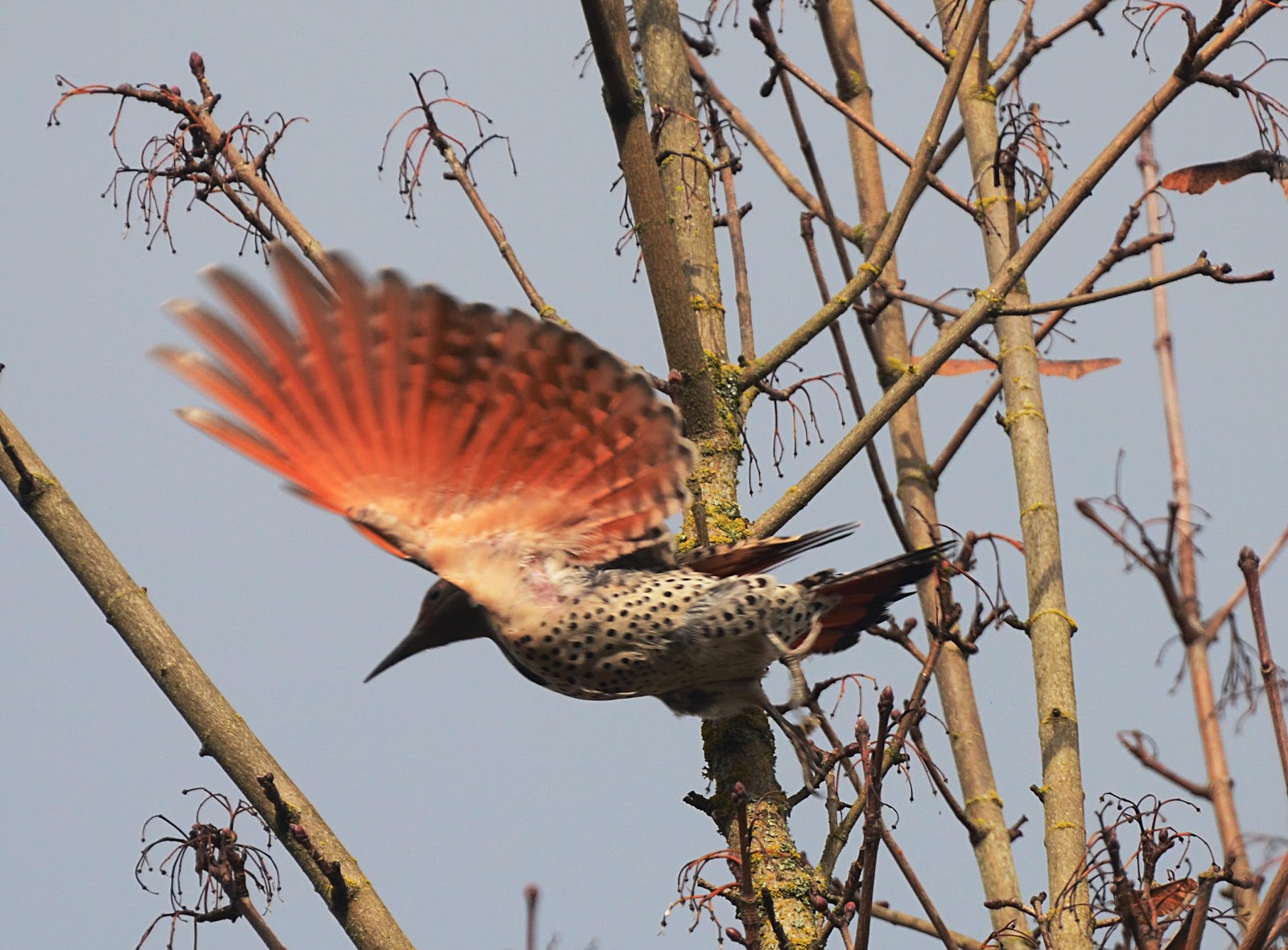
"We, Northern Flickers, like to excavate a cavity on a big tree, but if you prepare a nest box with sawdust, I might use it!"

Wednesday, November 21, 2012

A Smarty Pants, American Crow

An American Crow is much smarter than we think.  The other day I found an interesting article on the National Wildlife Federation's magazine.

 This article said that studies at UW in Seattle showed that American Crows could recognize the people's faces.  During the studies,  the researchers wore assorted masks and recorded how the crows behaved.   Later when the crows spotted a person wearing the mask worn during the banding process, they formed small mobs and scolded that person severely.

Amazingly even seven years afterwards, the crows clung to the memory and those born afterwards without actually experiencing the banding recognize the notorious face (the old ones must have taught young ones).  In addition, they can also recognize the faces associated with a good behaviour such as offering food. 

Wow, I have to behave good!!!  You, too.


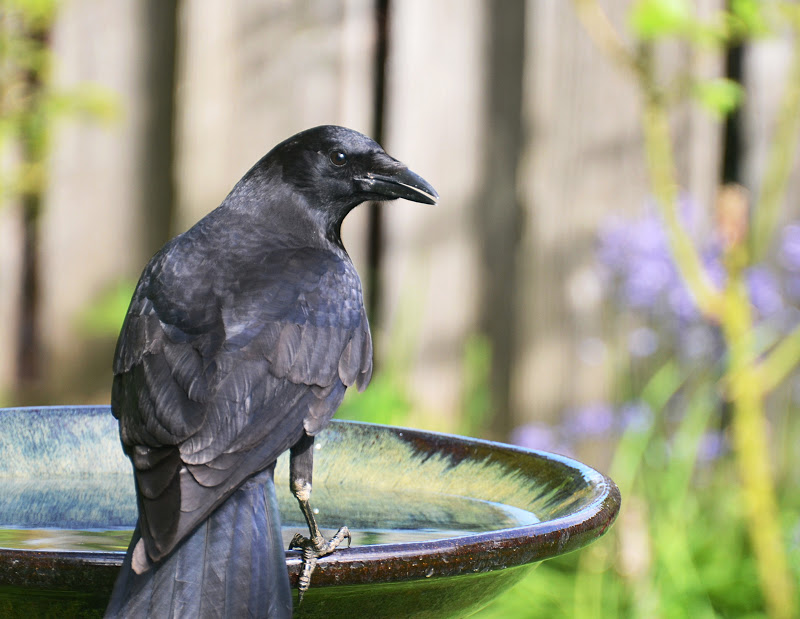
" That's why I remember you and your backyard."


"It's nice to be at a safe ground."


Backyard Owner:  "I pledge to be good everytime you and your buddies are around.  I only feed birds and take pictures.  No harm."

Thursday, November 15, 2012

Dinasaurs and Birds: Any Relation?

Over the weekend, I stopped by at a Natural History Museum in Seattle.  As I looked through the exhibits, one of them just hit me:  One small and fast dinosaur (Compsognathus) that existed on insects and small reptiles was a relative of the oldest known bird (Archaeopteryx). 

So now I know birds existed on the earth far longer than humans have.   I feel more respect towards them!!!  I am more willing to help them with what I can do.

Anna's Hummingbird:  " This sugar water is safe to drink.  No food coloring in it."
 

A flock of Pine Siskins:  "This water is so tasty because the backyard owner does not use chlorine to clean the bird bath."


Oregon Junco and Chestnut-backed Chickadee:
"We like the peanut-flavored suet for the winter energy."


Gray Squirrel:  "I am not a bird, but I can agree with you.  You have been helpful to me, too, 'cause this apple is delicious with no pesticides."

Saturday, September 29, 2012

One Kind of a Chicken - KFC in Kashgar

In Downtown Kashugar, a big screen TV on the building watches over the heavy traffic with many motor bikes. 


Everybody rides a motorbike there.  And there are many dressed-up, high-heeled women riders, too.


At one corner of the square, you will find a variety of fruits.   Find some different melon?


Here is something familiar: the origin of our bagels.   Notice one yuan Chinese money (Mr. Mao) for one bagel.


And you will also find our famous KFC.


Chinese people love to eat Kentucky Fried Chicken.

Thursday, August 9, 2012

Air Show Day - American Robin

Once a year  there is an Air Show in town.  Many years ago, I used to go there, hanging around under the hot sun all day.  But no more energy for such; I now watch from my backyard Air Force jets swishing by with the high pitched noise with a tailing smoke.

My camera is out for repair due to overuse.  With my old little automatic camera, these photos surprisingly came out.


Completing the show with the stunning burst.


Look!  A bird next to the jet.


After the show, birds were happy flying around, knowing no more ear-piercing noise. 


Under the sizzling heat of the weekend, a young American Robin came to the bird bath.   He/she must be the one fledged from the neighbor's Robin nest not long ago!  You remember the sleepy face in the nest I showed you a month earlier?
(Photos taken by my older SLR camera.)


Just wanted to be with his dad on the bath.


Splash, splash...

"You wanna be the next?  The coolest in town, the best thing there is under the burning sun!  See you later."

Sunday, July 22, 2012

A Super Vision

Out in my veggie patch, I have many zucchinis like many other gardeners.  Zucchinis are one of the easiest veggies to grow around here with only a lot of sun and water. 

A zucchini flower
Also, I started digging and found a few large potatoes. Using those fresh organic potatoes, I made a delicious potato salad.    


Birds like to visit my veggie garden to eat a bit of this or that such as soft leaves of Chinese peas, leaves of Sunflower, and so on.  One day, my Chinese painting teacher told me birds can tell the shape differences of leaves very easily to guide their flight. 

Today  I found a very interesting short article on a National Wildlife Federation's magazine regarding the birds' vision.

The summary of the article is as below:

1)  Bird's eyes have one more receptor for color vision, whereas human's only have three for red, green and blue.    This extra receptor enables birds to see the UV light.

2)  Birds have a tiny drop of colored oil in each receptor, whereas humans have none of it.   This enables birds to see the differences between two similar colors when humans can not.

Because of these above differences, scenes may appear more detailed and brighter for the birds.

Wow!!  No wonder they are always ahead of me when I am trying to find them.  They know exactly where and what I am doing.

A Scrub Jay was looking far beyond from the tree top with that super vision.


Then, seeing me down on the ground, it decided to come right down to get more peanuts.  
Spreading the wings


On the way, it is now like a bullet.

"I can see you very clear up on the tree top."


Even on the ground, he/she can find a bug hidden in the lawn.
" Look at this I just got."

Now I'm convinced that birds have a super vision.


Monday, June 25, 2012

Downy Woodpecker's Favorite

Some birds come to my backyard just to eat the suet, not bird seeds or sunflower seeds.  The price of a store-bought suet is going up,  so I decided to make a home-made one from scratch.

Bird Suet Recipe

Ingredients:
1 and 3/4 C flour
1/2 C bird seeds
1/2 C peanuts, unsalted, crushed
3/4 C lard or Crisco (veggie based solid oil)
1/4 C sugar

1)  Melt the lard or Crisco on a stove or microwave.
2)  Add sugar, and then bird seeds and peanuts.
3)  Add flour, and mix well.
4) If you have the store-bought suet's plastic square container, pour into two of these containers.   Or you can make any simple shape.
5)  When cooled and hardened some, take it out from the container and slide  into the suet feeder.

Ready to drop into the suet feeder


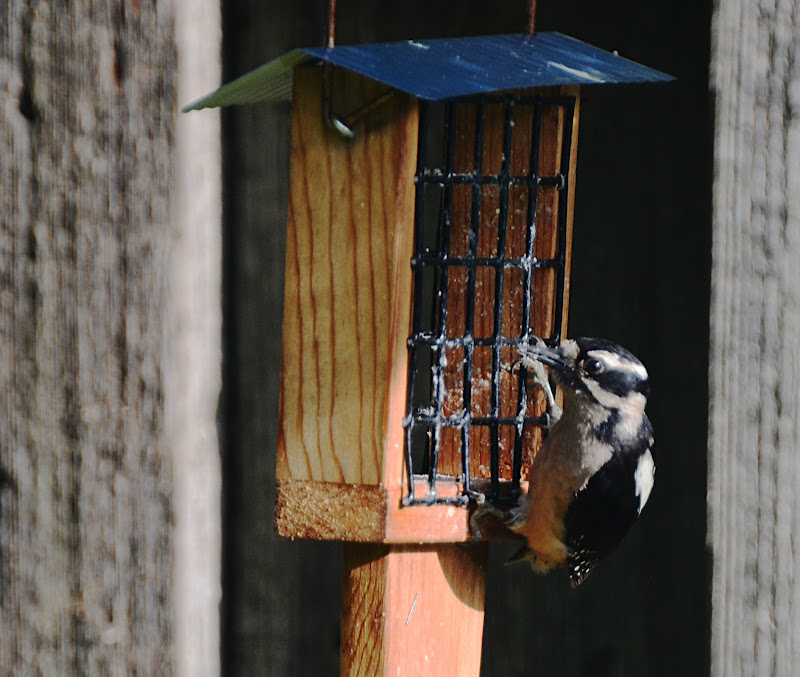
One of the birds who like the suet is the Downy Woodpecker.


A week ago, a pair of Downy Woodpeckers stopped over after many months of absence.  Mr. Downy was on the apple tree, looking over the suet hanging at the wisteria.
"Is there any suet left at that feeder?"

I got a bad news for you, woody.  The other day a herd of European Starlings raided on that suet.  It took them only one day to finish.  Being so discouraged, I could not replenish it.  But if only I had known you would be over, surely I could have placed one for you ...


"Oh, no....  Nothing left.  I just have to scrape the left overs on the metal."


To make the matter worse, he was with his mate!!
"The backyard owner has been generous in the past.  So she must be out of town."


Backyard Owner:  "How kind of you.  I will try to be a better backyard owner for you.  So come back again before too long."


Monday, May 28, 2012

Who's singing?

Where's the bird?


Who's singing?


Western Tanager (summer bird here):  "It's me.  I like to sing in the upper canopy, hiding from you!"


Black-headed Grosbeak (summer bird here):  "No, no, no.  Me.  I am a good singer from the south."


American Robin (regular resident here):  "Listen, everyone.   Here in Oregon, that song belongs to me all the time."

Backyard Owner:  "I am confused.  Who could be singing like that?"


A couple of bird books say their songs are similar.  In winter, I know the song belongs to American Robin, but in summer, I can be sure only when seeing whoever is singing. 

Here is another reason to keep bird-watching.

Friday, May 11, 2012

Birdbath Basics

A birdbath is almost as important as bird food.  Why?  The water is first for drinking, and, second, for bathing.  Especially when you don't have any creek or river nearby. 

When placing a birdbath in your backyard, please follow these guidelines:

1) Keep nothing within 2 feet around on all sides since the birds are vulnerable with wet and heavy feathers.  No preditors are allowed nearby.
2) Have a small tree within a few yards for an emergency refuge. 
3) Change the water daily, and scrub the algae and droppings as needed.

Now your birds are ready to enjoy the birdbath just like my backyard friends:

Black-capped Chickadee:  "On a hot day, it's nice and cool."

Oregon Junco:  "When it gets very hot, I'll escape to the mountains.  But until then, I can take a bath here to cool down."

Evening Grosbeak:  "Daily glassful of water is good for health - I heard it on the bird news."

House Finch:  "The fresh morning water can't be underlined enough.  Do I look sound and well?  Certainly I am."


Scrub Jay:  "Ummm, good.  I just saw the backyard owner changed the water.  A taste of fresh water!!"

American Goldfinch:  "I'll send you a kiss to the conscientious backyard owner.  Hurray!!"

I hope your bird friends will love the fresh water this summer to stay clean and healthy.


Sunday, April 22, 2012

Just a Little Help Goes a Long Way

When I was checking on the Audubon Society Website, I noticed they were asking people to remove Invasive Plant Species because many invasive non-native plant species destroy native habitat for birds survival.   Five of the most common ones around Oregon are English Ivy, Himalayan blackberry, Garlic Mustard, Japanese Knotweed and Clematis. 

A few years ago,  I had a huge mound of overgrown English Ivy around the  pine tree in the backyard.   One day I decided to get rid of it.  I really WORKED till exhaustion for several days in pulling those vines.   My back and fingers were sore for sometime, but I was glad I did it.   So my message to you is to get rid of it before it gets out of hand.


The Orange-crowned Warbler can appreciate my hard work.
"That's why I can find a lot of food in the backyard.  I like your bugs, pear blossoms, and blueberry flowers particularly."

"See, I have to raise young ones here, so an ample supply of food is really appreciated."


A female Roufous Hummingbird says, "When I come to Oregon for summer, I always like to drink blueberry nectar here!"

"And this time I just have to figure out what's on the ground here.  This looks like my favorite little spider web.  Glad the English Ivy did not take over here."

During summer, any little help you can do to make your backyard bird friendly will be much appreciated.